
Three layers of competition, not one
The automotive A/C compressor aftermarket is usually described as a price ladder: original equipment, premium aftermarket, economy, rebuilt. That description is not wrong, but it is flat. Look at how the market actually clears and at least three distinct competitive games appear. Retail competition happens inside quality tiers, where a part is sold as good, better or best and the buyer chooses a shelf position rather than a specification. Manufacturing competition happens on scale and scope, where the winner is the firm that can cover thousands of part numbers at a cost that still leaves a margin. And a third contest happens upstream, over cores, data and access to the vehicle, where control of an input rather than efficiency of output decides who can compete at all.
For a catalogue business the distinction matters because the strategies are not interchangeable. A firm that wins on coverage cannot automatically win on cores, and a firm that wins on retail tiering can be shut out by an access decision taken elsewhere in the chain. The published evidence on each layer is more specific than the industry's own folklore, and it points to where margins actually sit.
Layer one: tiers, shelves and the structure of hard-part retail
The clearest empirical account of aftermarket retailing comes from a study of a U.S. specialty automotive parts retailer with 3,400 stores. The authors documented the institutional peculiarities of "hard parts" — failure-related components that a customer buys only when something breaks. There is no syndicated data of the kind that grocery retailing relies on; each subclass of a hard-part category contains variants ordered by quality, typically labelled good, better and best; there is competition within a subclass but not between subclasses; market shares of variants and their prices are not positively correlated; and a customer enters the market infrequently and buys one variant, one unit (Mantrala, Seetharaman, Kaul, Gopalakrishna and Stam, 2006).
Two implications follow for compressors. First, the tier structure is not a marketing veneer; it is how the market resolves the fact that buyers cannot easily verify quality before installation. Each tier is a different promise, and the price gaps between them are the market's estimate of the risk difference. Second, because purchases are infrequent and data are thin, shelf position and catalogue presence carry more weight than they would in a category with continuous repeat purchase. A distributor's decision about which compressor brands to list is therefore a decision about which tiers to offer, and a manufacturer's decision about which distributors to serve is a decision about which tier it is actually competing in.
Layer two: scale and scope across a 1,900-reference catalogue
The second game is manufacturing economics, and it is shaped by the extraordinary breadth of the catalogue. The A/C compressor catalogue published by this site holds 1,903 part numbers, of which 1,839 are compressor references spread across 22 brand programmes, from Toyota and Nissan volume applications to narrow Mercedes-Benz, Land Rover and bus lines. Figure 1 shows how concentrated that range is: Toyota and Nissan alone account for 1,183 part numbers, while twelve brand programmes account for 43 between them.
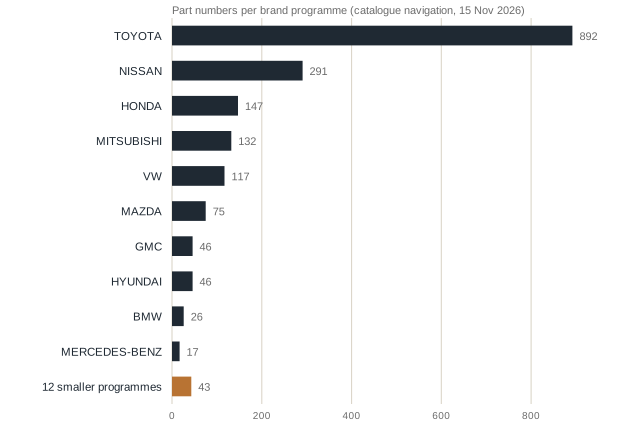
That breadth is not decoration. It is a scope strategy: a supplier that can serve many part numbers amortises tooling, purchasing and quality systems across a wider revenue base, and can offer distributors a single-source relationship instead of a dozen small ones.
Evidence on how such breadth is achieved comes from trade data. A study using Chinese Customs Office records at the eight-digit HS product level for 2000 and 2008 decomposed China's automotive exports into vehicles and parts/components, and distinguished foreign firms, domestic public firms and domestic private firms. It calculated both the extensive margin — the number of products exported — and the intensive margin — average export value per product — and estimated gravity equations to explain them (Wang, Lee, Kim and Park, 2015). The finding that matters here is heterogeneity: the export profile of parts and components is not a scaled-down version of vehicle exports, and different firm types occupy different positions along the extensive and intensive margins.
Translated to compressors, the extensive margin is catalogue coverage and the intensive margin is volume per reference. A manufacturer can grow by adding references for thin applications or by deepening volume on high-runner references, and the two paths demand different capabilities. Adding references requires engineering and data work — fitment validation, cross-reference maintenance, small-batch production. Deepening volume requires cost discipline and capacity utilisation. Most firms are good at one and mediocre at the other, which is why the middle of the market is crowded and the extremes are not.
Layer three: cores, remanufacturing and the fight for supply
The third layer is the least visible and possibly the most decisive. Remanufacturing — restoring used units to working condition — competes with new production, and its economics depend less on labour cost than on access to cores: the used units that feed the process. Research on automotive component remanufacturing describes core supply as a central challenge and identifies the arrangements firms use to secure it, including agreements with original equipment manufacturers, core brokers and other market actors, as well as independent collection. The authors stress that whichever route is chosen has to be lucrative for the parties involved (Lind, Olsson and Sundin, 2014).
Core access is a barrier to entry that does not appear in a price list. A remanufacturer without reliable cores cannot plan volume; a new-parts manufacturer without a reman programme has no answer when a distributor wants a lower-cost tier. The competitive consequence is that the reman segment tends to consolidate around firms that have solved collection logistics, not around firms that have the best machining. And the segment is being reshaped by electrification: a study combining theory and empirical data on the effects of electric vehicles on automotive remanufacturing finds both challenges and opportunities as the installed base shifts away from internal-combustion architectures (Casper and Sundin, 2020). Compressors are part of that shift, because electric vehicles use electrically driven compressors with different wear profiles and different remanufacturing economics from belt-driven units.
Meanwhile, the incumbents are moving. A review of remanufacturing business models notes that original equipment manufacturers are shifting towards remanufacturing and investing in it, driven by circularity, environmental legislation and profit motives (Gunasekara, Gamage and Punchihewa, 2021). When the OEM enters the reman tier, the independent remanufacturer's cost advantage narrows and the fight moves to core control and brand trust. That is a structural change, not a cyclical one, and it is already visible in the remanufactured versus new segment of the catalogue.
The upstream lever: aftermarket power and digital access
Competition in aftermarkets has a long antitrust history, and the OECD's review of the economics and enforcement practice is a useful map. It examines how aftermarket cases are assessed, focusing on market definition and market power, and on the enforcement questions that arise when a firm controls the primary product and the secondary market (OECD, 2017). The classic concern is lock-in: if a vehicle constrains which parts or services can be used, the supplier of the vehicle can extract rents downstream.
Digitalisation has moved that lever from hardware to data. A study of access to digital car data and competition in aftermarket maintenance services describes how manufacturers had already partly foreclosed the maintenance market through franchised dealer networks, and how the arrival of real-time digital car data upsets the balance: manufacturers can collect maintenance data on their servers and send messages to drivers, which can be used to price-discriminate and shift share toward official dealers. The authors identify at least four alternative technical gateways that could give independent providers access (Martens and Mueller-Langer, 2020).
For a compressor supplier, the lesson is that access to vehicle data and diagnostic information is a competitive input in the same way that cores are. A catalogue built on part numbers is robust to changes in retail tiering, but it is exposed if fitment or diagnostic data becomes gated. The firms that will hold position are those that treat data coverage — cross-references, applications, service information — as a production asset rather than a marketing expense.
What the three layers imply
The evidence supports a fairly unsentimental conclusion. Competition in this market is not a single contest that a firm can win by being better at everything. It is three contests with different entry costs and different failure modes. Retail tiering rewards distribution relationships and brand consistency. Manufacturing breadth rewards engineering data and small-batch production discipline. Core and data control reward long-term supply relationships and regulatory positioning.
A manufacturer in Chongqing with a broad A/C catalogue and an air-suspension line is, whether it says so or not, running a scope strategy in a market where volume is contested by larger firms and cores are contested by remanufacturers. The defensible position is not the cheapest reference or the widest catalogue alone, but the combination that a distributor cannot easily replicate: coverage of the applications that move, validated data, and a supply relationship that survives the next refrigerant transition. That combination is what the three-layer view makes visible, and it is a better guide to strategy than the price ladder the industry usually describes.
Sources
- Mantrala, M. K., Seetharaman, P. B., Kaul, R., Gopalakrishna, S. and Stam, A. (2006). "Optimal Pricing Strategies for an Automotive Aftermarket Retailer." Journal of Marketing Research, 43(4), 588-604. https://doi.org/10.1509/jmkr.43.4.588
- Wang, J., Lee, H. H., Kim, K. T. and Park, D. H. (2015). "Firm and Product Heterogeneity in China's Automotive Exports." The Asian Journal of Shipping and Logistics, 31(4), 449-457. https://doi.org/10.1016/j.ajsl.2016.01.003
- Lind, S., Olsson, D. and Sundin, E. (2014). "Exploring inter-organizational relationships in automotive component remanufacturing." Journal of Remanufacturing, 4(1). https://doi.org/10.1186/2210-4690-4-5
- Casper, R. and Sundin, E. (2020). "Electrification in the automotive industry: effects in remanufacturing." Journal of Remanufacturing, 11(2), 121-136. https://doi.org/10.1007/s13243-020-00094-8
- Gunasekara, H. N. W., Gamage, J. R. and Punchihewa, H. K. G. (2021). "Remanufacture for sustainability: a comprehensive business model for automotive parts remanufacturing." International Journal of Sustainable Engineering, 14(6), 1386-1395. https://doi.org/10.1080/19397038.2021.1990437
- OECD (2017). "Competition Issues in Aftermarkets." OECD Competition Law and Policy Working Papers. https://doi.org/10.1787/82258734-en
- Martens, B. and Mueller-Langer, F. (2020). "Access to Digital Car Data and Competition in Aftermarket Maintenance Services." Journal of Competition Law & Economics, 16(1), 116-141. https://doi.org/10.1093/joclec/nhaa005
Every factual claim in this article is referenced to a public source; the full list is in the Sources section above.