
The question, and the short answer
Ask four recent studies the same question — what should a buyer check when specifying an electric scroll compressor for an EV heat pump? — and a consistent picture emerges, though not the one most sourcing conversations start from. The compressor-level features that dominate datasheets and quotations are worth single-digit percentages: vapour injection improved heating performance by 2.4% to 4.9% in controlled experiments (Li et al., 2025), and scroll geometry has a measurable optimum. The refrigerant change the industry has already made costs roughly the same amount again — R1234yf modelled 4.41% below R134a in COP (Kabak & Hoşöz, 2025). The double-digit differences sit one level up, in cycle architecture: ejector-expansion systems modelled 10–30% above conventional layouts (Zhang et al., 2025), and a dual-evaporator configuration measured 11.2–50.0% higher COP than its single-evaporator mode in bench tests reported in the Chinese journal Fluid Machinery (Tan et al., 2025). The compressor still matters — including for durability, in ways the efficiency numbers hide — but it matters as part of a system specification, not as a standalone purchase. The rest of this article works through where the studies agree, where they pull against each other, and what we think buyers should do with that.
Where the studies agree: compressor-level gains are real, modest, and bounded
The most direct evidence on the compressor itself comes from Li and co-authors at Beijing Institute of Technology (International Journal of Refrigeration, 2025). They designed eight scroll configurations for EV heat pumps, varying the number of spiral turns and the vapour injection port placement, validated a new cycle model against experiments, and used three-dimensional simulation to examine internal temperature and pressure fields. Vapour injection improved heating performance by 2.4% to 4.9% over comparable non-injection designs. Scroll geometry showed a clear optimum rather than a "more is better" trend: 2.2 to 2.6 spiral turns maximised heating efficiency in their configurations, while increasing turn count raised heat generation and reduced COP.
Their result sits at the conservative end of what the wider literature reports for vapour injection, and the spread itself is informative. Zhang et al. (2025), reviewing the field, cite flash-tank injection systems improving performance by 5–15%, injection-pressure optimisation reaching roughly 20% heating COP improvement in one study, and an experimental 4.7% COP gain in another. These numbers are not directly comparable — they mix heating capacity, heating performance and COP, measured on different systems under different conditions — which is precisely the point. "Vapour injection gain" is not a single number a buyer can bank; it depends on what is measured and how well the injection is controlled. Li et al.'s figure is best read as the defensible floor: what injection delivers at the compressor, before system-level optimisation adds or subtracts.
The finding in Li et al. that receives least attention is arguably the most consequential. Compressors with three spiral turns (N = 3.0) showed higher internal temperatures, with a risk of localised high-temperature accumulation near the discharge port. Sustained high discharge temperature is the condition that stresses lubricant and accelerates wear in any compressor. A geometry choice that looks neutral on a capacity table can therefore carry a thermal cost that only appears over service life — and none of the four studies reviewed here measures that cost directly, a gap we return to below.
Where the leverage actually sits: cycle architecture
If compressor internals are worth single digits, system architecture is worth tens. Zhang et al. (2025) modelled two ejector-expansion heat pump configurations for EVs across six Chinese cities and four refrigerants, benchmarking them against conventional and vapour-injection systems. The single-evaporator ejector system improved COP by 10–30% over the conventional baseline; the dual-evaporator ejector system by 7–15%. In their overall ranking, the ejector systems sat above the vapour-injection system, which sat above the conventional one. Tan et al. (2025), working experimentally rather than in simulation, found the same direction of effect from a different design choice: at 60–90% inlet air humidity and 4,000 r/min compressor speed, their dual-evaporator mode delivered 26.6–67.6% more effective heating capacity and 11.2–50.0% higher COP than the single-evaporator mode of the same system.
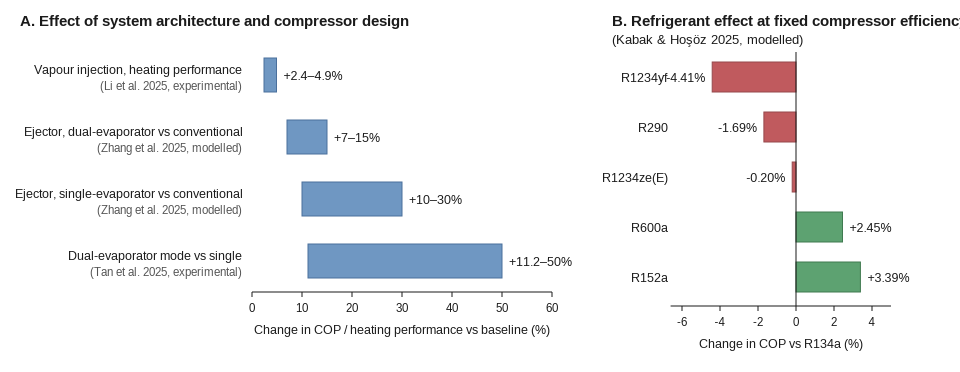
Two cautions belong with these numbers. Zhang et al.'s ejector results are thermodynamic modelling, not bench measurements, and their own review notes that experimental ejector work in EVs has shown strong cooling-mode gains but heating capability that "substantially diminished under subzero conditions" in at least one test programme. And Tan et al.'s wide COP range (11.2–50.0%) reflects how strongly the dual-evaporator advantage depends on humidity and operating point. Architecture offers the largest gains in this literature and also the widest uncertainty bands.
The refrigerant is a bounded, known penalty — but read the fine print
Kabak and Hoşöz (2025) modelled a mobile air conditioning system in REFPROP 9.1 — evaporating temperature −2 °C, condenser temperatures of 40 and 50 °C, cooling loads of 3–7 kW, compressor isentropic efficiency fixed at 55% — and compared R134a with five lower-GWP alternatives. R1234yf averaged 4.41% lower COP and 4.34% lower exergetic efficiency than R134a. R1234ze(E) was nearly neutral (−0.20%), R290 modestly negative (−1.69%), and R152a and R600a positive (+3.39% and +2.45%), though both carry flammability constraints that limit vehicle use. Our earlier R134a vs R1234yf A/C compressor guide looks at the same transition from the compressor hardware side. Because compressor efficiency is held constant, these figures isolate the refrigerant's own thermodynamic effect: the starting penalty or bonus a system design must work with.
Here the studies create a productive tension. Zhang et al.'s system-level accounting found that a vapour-injection system's COP could fall below the conventional system's at mild ambient conditions for some refrigerants — not because injection stops working, but because injection's real contribution at extreme cold is heating capacity and avoiding auxiliary PTC heating, which a mild-condition COP figure does not credit. In other words, the refrigerant penalty is a fixed thermodynamic fact, while the injection benefit is conditional on climate and duty cycle. Comparing the two as if they were the same kind of number — a temptation in quotation spreadsheets — misprices both.
Our assessment
Three conclusions follow, in our view, when the four studies are read together rather than separately.
First, specification effort is currently misallocated. Buyers interrogate compressor nameplate data — displacement, voltage, rated points — while the evidence says the double-digit differences are decided by cycle architecture and controls around the compressor. The compressor questions that matter most are the ones that connect it to the system: the low-ambient performance map, injection behaviour under the vehicle's control strategy, and discharge-temperature behaviour at the worst operating point.
Second, vapour injection should be bought as cold-climate capacity insurance, not as an efficiency feature. Its measured compressor-level gain (2.4–4.9%) is roughly the size of the R1234yf penalty (4.41%) — the two approximately cancel in an efficiency budget — while its capacity and PTC-avoidance value at low temperature is where Zhang et al.'s accounting shows it earning its place. A fleet operating in mild climates may rationally weight it less than a fleet heating through northern winters.
Third, discharge temperature deserves to be a contractual validation item, not a footnote. It is the only durability signal anywhere in this literature — Li et al.'s N = 3.0 temperature accumulation finding — and it is inferred from simulation and temperature fields, not measured over a service life. Until endurance data catches up, asking a supplier for discharge-temperature evidence at the specified worst case is the cheapest risk reduction available to a buyer.
What to ask when specifying
For distributors, workshops and fleet buyers, the practical checklist is short. Ask for the performance map at low ambient temperatures, not only at the standard rating point — the differences documented above appear in the cold, where EV heating demand and range loss are worst. Ask whether the compressor uses vapour injection and how the injection is controlled, and weight the answer by your climate. Ask about scroll design and discharge-temperature behaviour during validation, alongside the usual endurance evidence; two compressors of similar displacement can differ on both. And when comparing quotations across refrigerant platforms, treat the refrigerant's inherent COP difference as a known quantity — roughly four to five percent against R1234yf in modelled comparisons — and evaluate what the system design does to recover it, instead of expecting the compressor alone to close the gap. Single-digit percentages, compounded over a fleet and a service life, are where the money is.
Limits of the evidence
The boundaries matter as much as the findings. Two of the four sources are thermodynamic models rather than hardware tests: Zhang et al.'s ejector advantages and Kabak & Hoşöz's refrigerant penalties describe behaviour under stated assumptions, including a fixed 55% compressor isentropic efficiency in the latter. Li et al.'s optimal turns range comes from one research group's eight configurations and is not a universal constant; the published summary does not disclose every test parameter. Tan et al.'s dual-evaporator results are experimental but specific to their system, humidity range and compressor speed. No study reviewed here standardises test conditions against the others, none measures long-term durability outcomes, and none substitutes for application-specific validation data from the manufacturer of a specific compressor model.
Specifying with the evidence in hand
None of this changes what a compressor is for; it changes how precisely a buyer can specify one. The FIVER catalogue covers automotive A/C compressors, including electric compressors for EV and hybrid applications, and the most useful enquiry a buyer can send is one that states the operating conditions that matter — vehicle platform, refrigerant, voltage, and the coldest ambient temperature the system must heat through. Those are the conditions under which the differences documented above actually appear, and they are the right basis for matching a model to an application.
Sources
- Li, K., Tan, Z., Mohtaram, S., Tian, Y., Liu, N., Zhang, H., Yan, J., He, Q., Li, C., & Yang, T. (2025). "Injection performance analysis of scroll compressors with varying spiral turn configurations for electric vehicle applications: An experimental approach." International Journal of Refrigeration, 177, 65–78. https://doi.org/10.1016/j.ijrefrig.2025.05.016
- Kabak, E., & Hoşöz, M. (2025). "Thermodynamic performance comparison of a mobile air conditioning system for various HFO and HC alternative refrigerants to replace R134a." International Journal of Automotive Engineering and Technologies, 14(1), 25–37. https://doi.org/10.18245/ijaet.1536150
- Zhang, Z., Wang, Y., Zhou, Z., Guan, Z., Chang, L., & Yang, M. (2025). "Assessment of Ejector-Expansion Heat Pump Systems with Low GWP Refrigerants for Electric Vehicles." World Electric Vehicle Journal, 16, 505. https://doi.org/10.3390/wevj16090505
- Tan, M., Hu, J., Miao, Y., Gu, X., Li, C., He, Q., Zhang, T., & Li, K. (2025). "Research on dehumidification and heating performance of dual-evaporator heat pump system for electric vehicle." Fluid Machinery, 53(3), 9–16. https://doi.org/10.3969/j.issn.1005-0329.2025.03.002
Every factual claim in this article is referenced to a public source; the full list is in the Sources section above.