
Two compressors, two industries
An automotive A/C compressor and an air-suspension compressor are both called compressors and both sit in a vehicle, but they do different jobs with different physics. The A/C unit moves refrigerant around a closed loop to move heat. The air-suspension unit takes in atmospheric air, compresses it, dries it and delivers it to a reservoir that feeds air springs, leveling valves and, on commercial vehicles, air brakes. One is a refrigerant machine; the other is a pneumatic machine. The commercial consequence of that difference is that they sit in different supply chains, obey different standards and are exposed to different growth drivers — which is exactly why the air-suspension compressor line is worth watching from an A/C compressor business.
The technical literature on air suspension is thinner than the A/C literature, but it contains a striking empirical fact about market penetration that frames the whole opportunity.
The penetration gap is the market signal
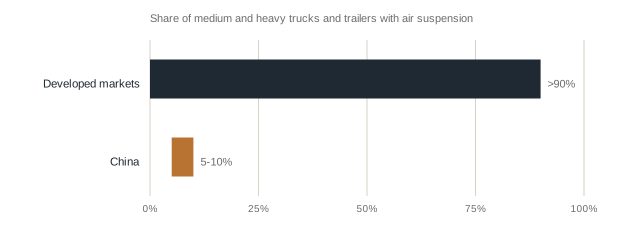
A 2019 study of electronic control air suspension (ECAS) for commercial vehicles states the gap plainly: in developed countries, air suspension application in medium and heavy trucks and trailers has a penetration rate above 90%, while in China the utilisation rate is much lower — the proportion of air suspension used in heavy trucks and trailers is only 5% to 10%. Figure 1 plots that gap.
The same paper sets out the advantages of ECAS over leaf-spring suspension and discusses the system's structure, its electronic control unit, sensors and solenoid valves (Tan, Hu, Dong and Chen, 2019).
That is the kind of number that matters more than a market-size forecast, because it describes a gap that regulation and vehicle specification can close. If a market with a large heavy-truck population is at 5-10% penetration while developed markets are above 90%, the direction of travel is visible even if the timing is uncertain. Each percentage point of penetration adds vehicles that need compressors, dryers, valve blocks, height sensors and control electronics — and, eventually, replacement parts.
For a components manufacturer, the strategic question is where in that adoption curve to position. The initial fitment market is dominated by tier-one system suppliers working with vehicle manufacturers. The aftermarket follows later, as the installed base ages and vehicles move out of warranty. The two markets have different technical requirements: original fitment demands full system validation and tight quality control, while the aftermarket demands coverage, cross-referencing and availability across a long tail of part numbers.
What the compressor actually does, and why it is hard
The air-suspension compressor's job sounds simple: keep a reservoir pressurised. In practice the duty cycle is demanding. The compressor must run quietly, because it operates while the vehicle is occupied and often at low speed. It must handle moisture, because compressed air carries water vapour that has to be removed by a dryer to protect valves and air springs from corrosion and freezing. It must tolerate frequent start-stop cycling as the leveling system corrects ride height, and it must do all of this without contaminating the air circuit with oil, because oil in the pneumatic system can degrade air springs and valves.
The air spring itself is a non-linear component, and the ride comfort it delivers depends on how the system is controlled. A study of the mathematical model of an air spring and its performance in a commercial-vehicle cab suspension highlighted the amplitude- and frequency-dependence of the air spring's stiffness characteristic, and validated the dynamic model against experiment (Tang, Zhu, Zhang and Sun, 2015). A separate study of damping modes in passenger-vehicle air suspension examined the structure and design principle of the system and analysed the damping effect, noting that reliability has attracted increasing attention as adoption has grown (Chen, Dong, Shi and Tan, 2019).
For the compressor designer, these system-level properties translate into specific requirements. The compressor's delivery rate and pressure ceiling determine how quickly the vehicle can level after loading. Its noise signature determines whether the system is acceptable in a luxury passenger car. Its moisture handling determines how long the dryer lasts and whether the valves stay clean. Its duty cycle determines the wear on bearings, pistons and seals. Reliability, in other words, is a system property again — but the failure modes are different from those of an A/C compressor.
Electrification changes the compressor requirement
The most interesting technical development is in commercial vehicles. Battery-electric trucks remove the diesel engine but not the air brake system, and air brakes need compressed air. A study of the requirement makes the point directly: air brake systems and their reciprocating compressors are incumbent, legislated and mature technologies integral to commercial trucks, and the introduction of the electric semi-truck will displace the diesel drivetrain over time, but the air brake systems and the requirement for an air compressor will not be displaced for the foreseeable future. The requirements will be inherited by the electric-semi industry, which will have to optimise the compressor for a platform that demands high energy density, high efficiency, low mass, excellent noise and vibration behaviour, and a small space claim (Jiang and Fitzgerald, 2021b).
That is a demanding specification, and it has pushed development away from the reciprocating compressor that diesel trucks inherited. A companion paper describes the development of a low-cost rotary screw compressor for electric truck air brake and suspension systems. The authors built an "Alpha" prototype using an existing rotor profile and size, tested it, and used the data plus numerical simulation to identify the root causes of lower energy efficiency before developing a smaller, more efficient package (Jiang and Fitzgerald, 2021a).
The significance of the rotary screw direction is that it trades the reciprocating compressor's pulsating delivery for smoother, continuous flow, which matters for noise and vibration in a vehicle that has no engine to mask it. It also shifts the manufacturing problem: rotor profiles, clearances and bearing arrangements become the critical tolerances, and the test regime has to cover efficiency across a speed range rather than at a single operating point.
Adoption in passenger cars brings manufacturing questions
Passenger-car air suspension is a smaller-volume, higher-value market, and its growth shows up in the industrialisation literature. A 2020 paper describes the engineering design of a pneumatically controlled manipulator for mounting an air-suspension compressor to the chassis of a sport-utility vehicle on an assembly line. The authors note that the device is not produced in serial production and that the prototype is the only functional unit — which is a useful reminder that air-suspension assembly is still being industrialised in many plants (Blatnický, Dižo, Barta and Rybicka, 2020).
The detail is not trivial. An air-suspension system adds components — compressor, dryer, valve block, reservoir, height sensors, air springs and piping — and each one adds assembly time, leak-testing requirements and warranty exposure. The compressor's mounting position affects noise transmission into the cabin, and its inlet and exhaust routing affect both moisture ingress and dust exposure. These are the practical constraints that determine whether a technically sound design becomes a reliable production vehicle.
What the two markets share
Despite the differences, the A/C compressor and air-suspension compressor businesses share a manufacturing core: precision machining, clean assembly, leak testing, performance testing and traceability. A company that already machines and assembles A/C compressors has much of the equipment and quality discipline needed for pneumatic compressors. What it does not automatically have is the system knowledge — the dryer and valve behaviour, the control logic, the pressure and duty-cycle envelopes, and the failure modes specific to pneumatic circuits.
That is why the air-suspension opportunity is best understood as an adjacent market rather than a simple product-line extension. It rewards the same manufacturing competence but demands a different validation regime, and its customers are often tier-one system suppliers or vehicle manufacturers rather than independent distributors. The aftermarket comes later, and it comes with the familiar problem of a long tail: many part numbers, intermittent demand and the need for accurate cross-references.
The evidence-based view of the opportunity
The empirical picture is a market with a large penetration gap in commercial vehicles, a passenger-car segment that is growing and still being industrialised, and a technical requirement that electrification is actively reshaping. None of that guarantees a particular company's success. It does suggest where the technical effort is likely to pay: compressing air efficiently and quietly, removing moisture reliably, tolerating frequent cycling, and proving durability over a duty cycle that is quite different from an A/C system's.
The A/C compressor catalogue at this site is organised mainly around A/C references — 1,839 of the 1,903 part numbers, across 22 brand programmes — with an air-suspension line alongside it, including Mercedes-Benz and BMW air-suspension parts. The A/C side provides the volume and the manufacturing base; the air-suspension side is the adjacent technical market where the same capabilities can be applied to a different problem. Watching the penetration numbers is a better guide to that market than watching the price of compressors.
Sources
- Tan, X., Hu, J., Dong, G. and Chen, B. (2019). "An Electronic Control Air Suspension System for Commercial Vehicles." IOP Conference Series: Earth and Environmental Science, 267(4), 042165. https://doi.org/10.1088/1755-1315/267/4/042165
- Jiang, B. and Fitzgerald, B. (2021a). "Development of a Rotary Screw Compressor for Electric Truck Air Brake and Suspension System." SAE International Journal of Commercial Vehicles, 14(3), 421-427. https://doi.org/10.4271/02-14-03-0034
- Jiang, B. and Fitzgerald, B. (2021b). "Development of an Optimized Rotary Screw Air Compressor for the Electrical Vehicle Air Brake Systems/Suspension Systems on Trucks." SAE International Journal of Advances and Current Practices in Mobility, 4(3), 936-942. https://doi.org/10.4271/2021-01-1281
- Blatnický, M., Dižo, J., Barta, D. and Rybicka, I. (2020). "Engineering design of a manipulator for mounting an air suspension compressor to a car chassis." Scientific Journal of Silesian University of Technology. Series Transport, 109, 5-16. https://doi.org/10.20858/sjsutst.2020.109.1
- Chen, B., Dong, G., Shi, Y. and Tan, X. (2019). "Research on Damping Mode of Passenger Vehicle Air Suspension System." IOP Conference Series: Earth and Environmental Science, 267(4), 042171. https://doi.org/10.1088/1755-1315/267/4/042171
- Tang, G., Zhu, H., Zhang, Y. and Sun, Y. (2015). "Studies of Air Spring Mathematical Model and its Performance in Cab Suspension System of Commercial Vehicle." SAE Technical Paper 2015-01-0608. https://doi.org/10.4271/2015-01-0608
Every factual claim in this article is referenced to a public source; the full list is in the Sources section above.